

How to calculate late payment fees
To calculate a late payment fee, follow the method written in your agreement with the customer. For a rate-based fee the usual formula is: overdue amount × agreed rate × time the payment is late, counted after any grace period. For a fixed fee, you charge the agreed amount once the grace period ends.
This guide explains each part of that formula, works through a clearly labelled hypothetical example, and lists what your agreement should spell out before you charge anything. It does not suggest a rate, and it is not legal advice.
Facts checked .
What is a late payment fee?
A late payment fee is an extra charge that a customer agreed to pay if a payment is not made by its due date. It only applies if the agreement says so, and the agreement decides how it is worked out.
A grace period is the number of days after the due date during which a payment is still accepted without a late fee.
Rate-based fee
A percentage of the overdue amount for each period the payment is late, for example per day, per month or per year. The fee grows the longer the payment stays unpaid.
Fixed fee
One set amount charged when a payment becomes late, or once for each overdue instalment. The fee does not depend on how many days have passed.
How do you calculate a late payment fee, step by step?
Take each overdue amount separately, find the time it is late after the grace period, apply the agreed rate or fixed fee, and round the result the way your agreement says.
- Read the late-fee clause. Note whether it is a rate or a fixed fee, the grace period, how time is counted, and any cap.
- Find the overdue amount. Use the unpaid part of each instalment or invoice that is past its due date. Unless the agreement says otherwise, do not include earlier late fees in this amount.
- Count the time late. Count the days (or months) from the date the agreement names: either the due date or the end of the grace period. If the payment arrived within the grace period, the fee is zero.
- Apply the formula. Rate-based: overdue amount × rate × time late, with the rate and the time in the same unit (for a yearly rate counted by day: overdue amount × yearly rate × days late ÷ days in the year). Fixed: the agreed amount.
- Apply any cap and round. If the agreement sets a maximum fee, stop there. Round to the sen, or as the agreement states.
- Show the fee separately. List the late fee as its own line, apart from the instalment or invoice balance, so the customer can see what is owed and why.
Repeat the steps for each overdue instalment. Two instalments that are late by different numbers of days give two different fees.
Worked example: late fee on an overdue instalment
In this hypothetical example, a RM 1,000.00 instalment paid 37 days late, under a 12% yearly rate counted by day after a 7-day grace period, gives a late fee of RM 9.86.
Hypothetical example Every figure below is made up to show the arithmetic. The 12% rate, the 7-day grace period and the RM 25.00 fixed fee are not suggested, typical or recommended values. Use the terms in your own agreement.
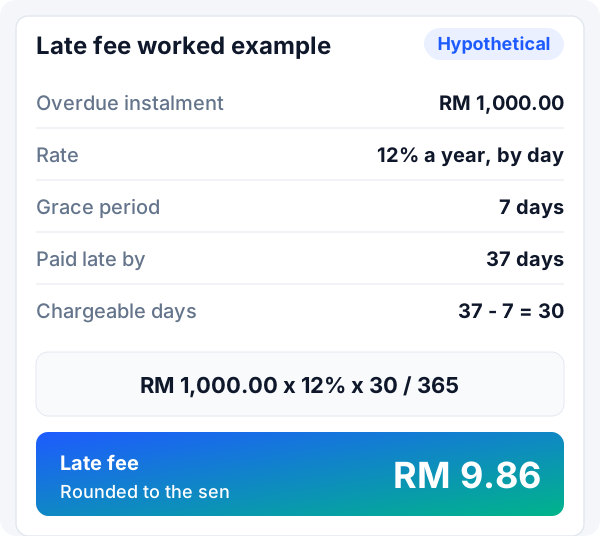
| Item | Hypothetical value |
|---|---|
| Overdue instalment | RM 1,000.00 |
| Agreed rate | 12% a year, simple, counted by day on a 365-day year |
| Grace period | 7 days; the fee is counted from day 8 |
| Paid | 37 days after the due date |
| Chargeable days | 37 − 7 = 30 days |
| Calculation | RM 1,000.00 × 12% × 30 ÷ 365 = RM 9.863 |
| Late fee (rounded to the sen) | RM 9.86 |
If the clause counts from the due date
Some agreements say that once the grace period has passed, the fee runs from the original due date. Then all 37 days count: RM 1,000.00 × 12% × 37 ÷ 365 = RM 12.16. The same payment gives a different fee, which is why the wording matters.
If the agreement uses a fixed fee
With a hypothetical fixed fee of RM 25.00 per overdue instalment after the grace period, the fee is RM 25.00 whether the payment is 8 days or 37 days late, and RM 0.00 if it is paid within the 7 days.
If two instalments are overdue
Work each one out on its own. A second RM 1,000.00 instalment that is only 7 days late is still within the grace period, so its fee is RM 0.00. The customer owes RM 2,000.00 in instalments plus a separate RM 9.86 late fee.
What should your agreement say about late fees?
Write the late-fee method into the agreement before the sale, in plain words the customer can follow, so that anyone can repeat the calculation and get the same answer.
Terms to spell out
- Whether the fee is a rate or a fixed amount, and its value.
- What the fee is charged on: the overdue instalment only, or something else.
- The grace period, and whether the fee then counts from the due date or from the end of the grace period.
- How time is counted: by day, by month or by part month, and the number of days in a year.
- Any maximum fee, and how amounts are rounded.
- Whether a part payment goes to the oldest instalment or to the fee first.
- When you may waive a fee.
Check before you charge
Whether a late fee can be charged, and how much, can depend on the agreement, the kind of sale and the law that applies to it. In Malaysia the general law on contracts is the Contracts Act 1950, and other laws can apply to particular kinds of sale or credit. You can read Malaysian laws on the official Laws of Malaysia site of the Attorney General's Chambers.
Ask a qualified legal adviser to review your late-fee clause for your own contracts. This guide states a calculation method only; it does not say that any rate or fee is appropriate for your business.
How does Colpay apply late fees?
In Colpay, you set a grace period and a late-fee policy, and Colpay applies it to overdue instalments. You can override a fee, waive it or restore it, and late-fee balances are shown separately from the instalment balance.
Set the policy once
Enter the grace period and the late-fee policy that match your customer agreement. Colpay tracks each instalment's due date, payment and balance, so it knows which ones are overdue.
Override, waive or restore
Change a fee for one customer, waive it as a goodwill gesture, or restore a waived fee. The late-fee balance stays separate, so the instalment balance is not mixed with fees.
Remind before fees grow
Overdue reminders by email or WhatsApp can combine all of a customer's overdue plans into one message, and can wait for your approval before they go out.
Colpay applies the policy you set; it does not decide whether a fee is suitable for your contracts. Colpay is business software for tracking payments. It is not a lender or a debt collector, and it does not move money for you.
Instalment payment tracking in Colpay · How to set up an instalment payment schedule · Payment reminder message examples · WhatsApp payment reminders · Customer statements of account
Frequently asked questions
Answers to questions people search for about late fees and overdue payment reminders.
How to calculate late payment fees?
Use the method written in your agreement with the customer. A common method is: overdue amount, multiplied by the agreed rate, multiplied by the time the payment is late, counted after any grace period. Some agreements use a fixed fee instead. Work out each overdue instalment on its own, round the way the agreement says, and show the fee separately from the amount owed. Check with a qualified adviser that your fee terms suit your contracts and the law that applies to them.
Wording and sending steps are in the payment reminder message examples.
Questions about this guide? Contact Colpay.